
Who Owns A Craft?
Reflections from the desk of Kiran Kittur, Founder of Arcisi.
Inheritance, community, and the authority to practise.
There is a legal answer to this question, and it is short.
The Karnataka Handicrafts Development Corporation holds the Geographical Indication for Kasuti embroidery. A GI tag is a property right. It fixes a name to a place and gives a body the standing to police the pairing. On paper, the matter is settled: Kasuti belongs to Karnataka, specifically the Dharwad district, and KHDC is its registrar.
That answer is useful. It regulates who may use the word, and leaves the larger one untouched; who actually owns the right to practise this craft? A GI tag protects a name. It does not explain who a practice belongs to, who is entitled to carry it forward, or what is owed to the people who kept it alive when nobody was watching.
To answer that question, there are multiple arguments and none of them suffice.
The historical answer might be more vague than what we read.
If you read almost anything written about Kasuti in the last twenty years, you will encounter a confident chronology. It originates under the Chalukyas, in the 6th or 7th century. Then there are more references dating to the 15th and by the 17th century, it is one of the 64narts a woman of the Mysore court was expected to master.
I went looking for the sources behind those claims. There are none.
Not "none that are easily accessible", None! that anyone names. The fifteenth-century literary reference appears in dozens of publications, from encyclopaedias to government craft archives, in wording that seems copy pasted across various websites and blogs. No title. No author. No manuscript. No line quoted.
The sixty-four arts claim behaves the same way: repeated across sources, never once footnoted to a seventeenth-century Mysore text. And the sixty-four arts, the chatuḥṣaṣṭi kalā, is itself a list that circulates in Sanskrit literature long before any Mysore court sat. To place Kasuti inside it is to borrow an old prestige and fit a regional folk practice into it after the fact.
The claim that it originates under the Chalukyas is the thinnest of all. There is no surviving object, no text or inscription that proves it with certainty.
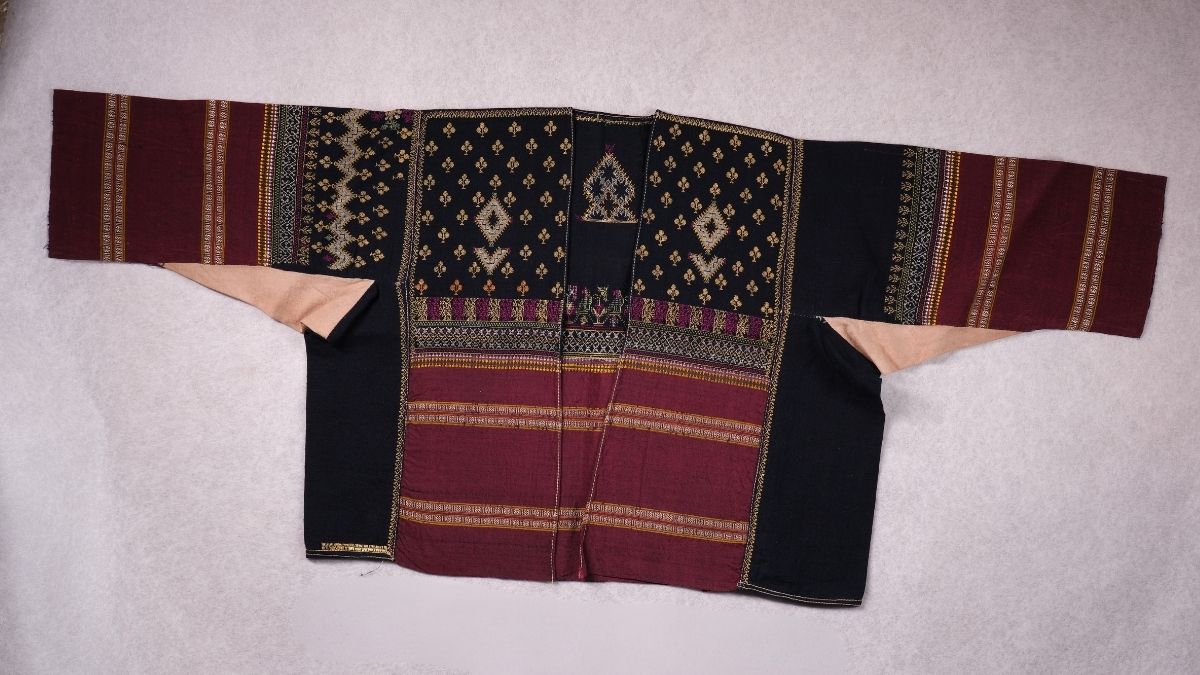
The oldest confirmed piece comes from the Dr Bhau Daji Lad Museum in Mumbai that holds a cotton blouse from Dharwar, worked in Kasuti, catalogued to between 1890 and 1950. Dig further, the Bombay Presidency gazetteers for Dharwar and Bijapur were compiled in 1884, a more rigorous scholarly cataloguing came in 1973, with Irwin and Hall's volume for the Calico Museum. The documented history of this craft is roughly a hundred and thirty years deep. Everything before that is attribution, not evidence.
The finding is more interesting than the myth it replaces. It is a domestic women's practice, largely un-monetised, unsigned, conducted in households and therefore invisible to a colonial revenue survey. Someone somewhere or maybe the community as a whole has been attributing the craft form to legends of the past. The reaching backwards is itself an act of value-making, and it happened inside Indian heritage discourse.
The gap between the story and the record is the thing worth studying. Why did that come about?
The answer might need us to widen the net a bit further.
The signature stitch of Kasuti is gavanti: a double-running stitch, worked in two passes, producing a line identical on both faces of the cloth.
It is also the Holbein stitch of Spanish and English blackwork. It appears in Austrian and Hungarian counted-thread traditions. It recurs, under different names, across Eurasia, because a double-running stitch is not an invention so much as a solution, probably to patch up used clothes and enough people mending will arrive at it independently. Similarities can be noted in Japanese Sashiko embroidery.
So the technique might not have a specific origin, not one culture can hold the title to reversibility of the craft. What is local is not the stitch but the vocabulary it is made to speak: the gopura, the ratha, the palanquin, the lamp, the sacred bull, all motifs drawn from Shaivite iconography and the temple architecture of the northern Karnataka region. The grammar is shared. The words are not.
This matters for anyone claiming authority over a craft. If your claim rests on technique, you are standing on ground that runs beneath half the world.
The community might be the strongest answer
Looking at modern day practitioners and their living memory, Kasuti developed principally within the Lingayat community of northern Karnataka, a Shaivite tradition founded in the 12th c. and spread outward from there. It was worked in the districts of Dharwad, Belgaum, Bijapur, Jamkhandi, Miraj, Sangli. It went onto Ilkal saris, Kubsa blouses, and became a part of the woman’s trousseau.
It was made by women, at home, for their own households, and it was not sold, and maybe that's why it has not lent itself to any record that survives as it was not part of the trade.
If ownership follows from custodianship then it belongs to the people who carried a practice through their hands and homes. Not to a dynasty. Not to a government body. To households in a handful of districts, transmitted mother to daughter, for as long as anyone can establish and almost certainly longer.
Hence, the inheritance answer holds more relevance than the entire argument
I hold a blouse worked in Kasuti, made by a woman in my mother's line, dated to between 1895 and 1910.
It is not proof of ancient origin; it dates to the same window as the earliest specimens any museum can confirm. It confers no legal right nor does it make me an authority.
What it does is place my family inside the documented record rather than outside it. The blouse in the Bhau Daji Lad collection and the blouse in my family's keep are the same evidentiary thread. One was catalogued and one was simply kept in a cupboard.
But, it still makes the transmission legible. A woman worked on this cloth, a woman whose stories I know, her hands made it, patiently counting threads. The practice moved forward through women who never stopped telling stories to their grandchildren. That is a form of evidence, but it is a form the archive will never hold.
The Practise in contemporary times must tell every story
I think the honest position is that a craft is not owned in the way an object is owned. It is held, in overlapping and unequal ways, by a community that made it, a state that registers it, a history that records it, and the families that carried it. Each of those claims is real.
What follows from that is a practice rather than a permission.
ARCISI works the reversible, knotless, counted-thread technique. It does not use the word Kasuti to name a product, and it does not claim descent from an empire it cannot evidence. The motifs are our own. The technique is structural, the reason a cloth has no wrong side and the technique, as established above, belongs to no one.
What we owe is not credit to a dynasty. It is attributed to the households of northern Karnataka, ensuring the right remunerance to the hands doing the work, and a refusal to sell a heritage narrative we know to be unsourced. If a claim cannot survive a footnote, it should not appear in a brochure.
The question in the title does not resolve. But it does clarify. Ownership, in craft, is better understood as a set of obligations than as a claim and owed to the people who still practise it.
To commission a piece, email us at arcisi.trade@gmail.com