The Craft
The slow geometry of Kasuti. Tracing the mathematical, knotless running stitches from Badami to Hampi and South Indian artisan hands.
The Geometry of Kasuti
Kasuti originated in the northern Karnataka districts of Dharwad, Belgaum, Bijapur, and Jamakhandi during the Chalukya period (6th-12th centuries) and flourished under the Vijayanagara Empire. The name "Kasuti" comes from "kai" (hand) and "suti" (cotton), meaning hand-worked cotton. In more recent history, the women courtiers in the Mysore Kingdom in the 17th century were expected to be adept in 64 arts, with Kasuti being one of them.
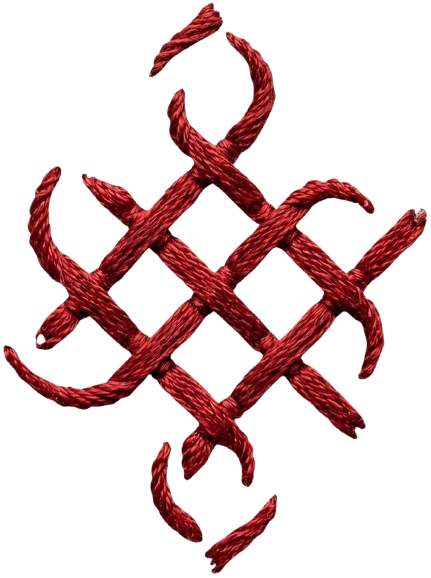
Running parallel to the architectural splendor was Kasuti, a traditional form of embroidery characterized by counted-thread work executed without knots on the reverse side, making both sides of the fabric equally beautiful. Kasuti employs four distinctive stitches—Gavanti (double running stitch), Murgi (zigzag), Negi (weaving stitch), and Menthi (cross stitch)—to create geometric patterns, stylized flora and fauna, and temple motifs inspired by the very architecture of Hampi.
Our artisans train with us for twelve to eighteen months to master the double-sided knotless technique.
Trace the Four Stitches
Click the tabs to select a stitch, then toggle between the Front and Reverse sides to see how the mathematical knotless patterns render.
Gavanti
Gavanti is a double running stitch that flows in straight, horizontal, vertical, or diagonal directions. The needle traces the geometric pathway forward and then doubles back to fill the gaps.
The Speed of Kasuti
Kasuti embroidery is extraordinarily time-intensive, and the unique reversible technique cannot be replicated by a machine. The embroiderer must count each individual thread of the base fabric, maintain perfect tension without knots, and ensure both sides look identical. It is meditative, painstaking work requiring sustained concentration and skill honed over years.
A single border can take anywhere from 15 days to several months to complete, depending on the intricacy of the design. A fully embroidered piece might require 3–4 weeks of continuous work. Complex pieces with dense patterns and fine threadwork can take even longer—sometimes over a year for elaborate bespoke items.
15 - 90 Days
3 - 4 Weeks
Up to 1 Year
General & Customization FAQs
Answers to our most common shipping, return, customized intake commissions, and B2B trade program queries.
Own a Piece of Living History
Every tablecloth tells a story. Every cushion cover preserves a dying art. Every purchase supports an artisan's livelihood and ensures this 1400-year heritage continues to flourish in contemporary design.
Explore Bespoke Custom