The Cloth With No Back
Reflections from the desk of Kiran Kittur, Founder of Arcisi.
Every embroidered textile has two faces, and almost all of them hide one.
The front is the perfection, a motif or pattern with even tension, the face made to be seen. The back is where the work actually tells on itself, the zig-zagging threads, the knots, the ends left loose, in short a messy back. In most needlework this is simply accepted. There is a right side and a wrong side, a face and a hidden ledger, and the whole practice agrees not to look too closely at the second one.
The 3 of the 4 main stitches of Kasuti refuse that arrangement and they are:
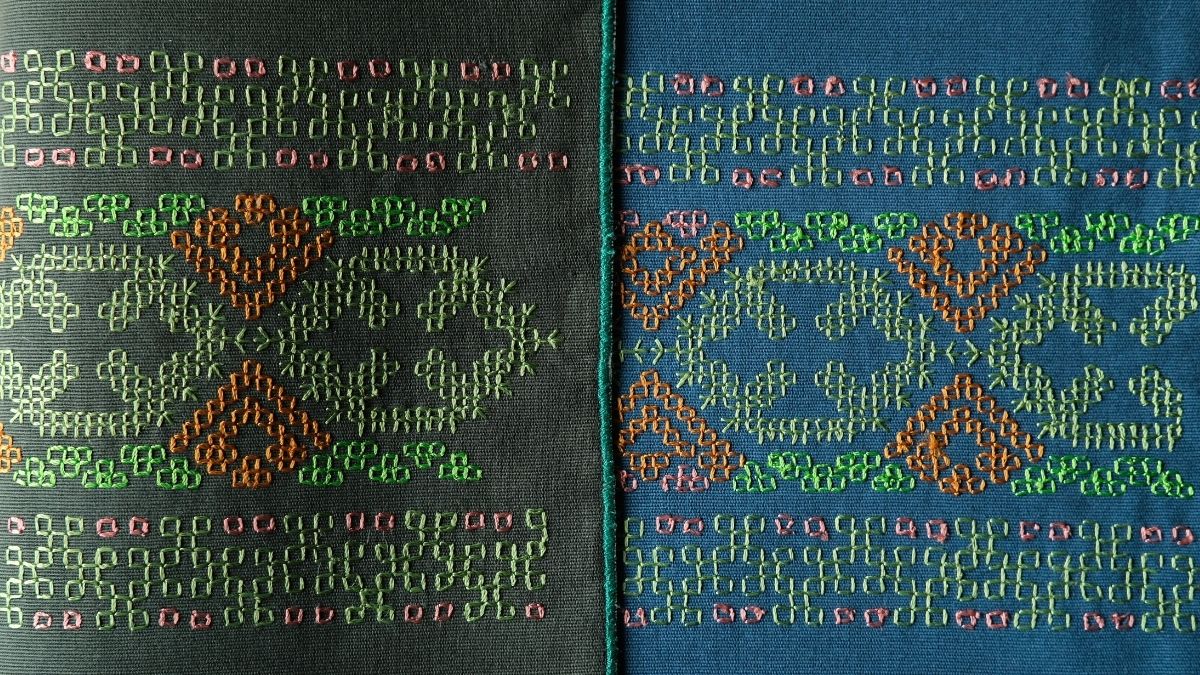
Gavanti is the double running stitch worked in horizontal, vertical, and diagonal directions. It forms the clear outlines of geometric patterns and is completely reversible, looking identical on both sides.
Murgi is a zigzag running stitch that looks like ladder steps.
Menthi is a simple cross-stitch named after fenugreek (methi) seeds. It has a heavier look and is used for filling in background spaces and dense areas.
The only stitch that isn't reversible is:
Negi or the darning stitch worked in long and short straight lines. It creates a woven fabric effect for larger motifs
The embroidery technique is mainly worked in two passes. In the first sequence the needle lays a broken line of running stitches along a path counted, thread by thread, into the weave of the fabric. On the return sequence, stitches come back along the very same path and fill every gap the first pass left.
What was a dotted line becomes a solid one, because the second pass occupies exactly the spaces the first pass skipped, the reverse of the cloth ends up carrying the identical solid line. Two faces, one line, built from a single continuous thread that never knots and never floats loose across the back.
That is a technical description. It is also our manufacturing standard.
A reversible piece cannot hide a shortcut. There is no discreet underside on which to hurry, no lesser face to finish to a lower tolerance because "no one will see it." The quality control is not a step at the end of the process; it is built into the geometry of the stitch itself. If the back is wrong, the front is wrong, because they are the same line. This is a rare and slightly uncomfortable thing to build a company on, because it removes the place most makers keep their margin.
It has another advantage too. A cloth with two good faces has, quite literally, twice the working life. A runner can be flipped when one side has had its years in the light; or flipped according to season, a spring/summer vibe and an autumn/winter one if you will.
A cushion that has no orientation it must be kept in. Or flip the cover over and use it it another room.
A now we add a disclaimer,
When we say "no wrong side," we are describing the double-running line specifically, not making a blanket claim about a whole tradition. Precision is the point of the exercise.
And also reversibility is not ours to own. The double-running stitch has roots in other traditions as well, in Spanish and English blackwork, Austrian and in Hungarian counted-thread work. We didn't invent it. We're not claiming a lineage on it. What we can do is honour what it demands: a piece finished to the same standard on every face, priced for the hands that can actually hold two faces to one tolerance, and sold without a hidden side in the object or the story.
Turn the work over. That is the whole test.
If a piece has a side you'd rather the buyer didn't inspect, it isn't finished. That's the standard we build to. Commissions & trade inquiries arcisi.tradegmail.com / +91 9356625152